
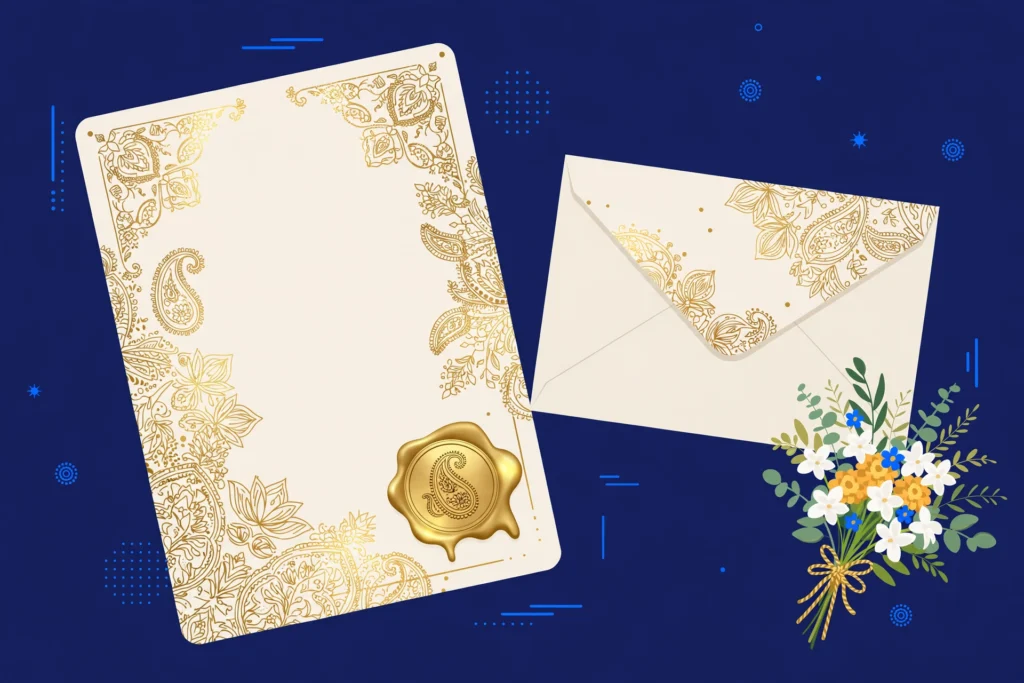
A wedding card in Pakistan is never just a card. It is the first thing the family sends out, the thing elders keep, and — in shaadi season, roughly October to March — the job every printer in Lahore, Islamabad and Karachi is busiest with. Ask five printers what a card costs and you will get five different answers, from under Rs 100 to over Rs 3,000 a piece, and every one of them will be telling the truth about a different card. This guide prices the actual cards, per card, so you can budget before you fall in love with a design you cannot afford at 300 copies.
One rule before the numbers: every range below is a typical market range seen in Pakistan in 2026, not a promise. Prices move with paper rates, with how many cards you order, and with how much handwork a design needs. Anybody who quotes you an exact per-card price before seeing your design, your paper and your quantity is guessing.
Wedding card prices in Pakistan in 2026, per card
| Card type | Typical price per card | Best for | What is usually included |
|---|---|---|---|
| Budget — standard cardstock, single insert | Rs 80 – Rs 250 | Big guest lists (300–500+ cards) | Heavy cardstock, matching envelope, simple print |
| Mid-range — foil, embossing, vellum wrap | Rs 250 – Rs 500 | Most weddings, all functions | Premium finish, one or two inserts, envelope |
| Premium — acrylic, laser-cut wood, designer artwork | Rs 500 – Rs 1,500 | Nikkah and Barat, smaller lists | Custom artwork, wax seal, coordinated inserts |
| Luxury boxed — velvet or hardcover box sets | Rs 1,500 – Rs 3,500+ per box | Close family, elders, special guests | Gift box, printed inserts, ribbon, sometimes a favour compartment |
A note on the spread: premium vendor studios quote higher than the ranges above — some Lahore studios list simple vellum cards from Rs 250, acrylic from Rs 300 and velvet invitations from Rs 400, with boxed sets from about Rs 5,000 a box. The ranges in the table are the market-wide picture; a named studio with its own workshop will sit at the top of its tier, and a wholesale printer in a paper market will sit at the bottom. Both are real prices for different buying experiences.
What a real order costs: three examples
| Guest list | Card choice | Rough total (cards only) |
|---|---|---|
| 500 cards | Budget cardstock at ~Rs 120 | ~Rs 60,000 |
| 300 cards | Mid-range foil/vellum at ~Rs 350 | ~Rs 105,000 |
| 150 cards | Premium acrylic at ~Rs 800 | ~Rs 120,000 |
Notice what the table shows: the “expensive” card is not always the expensive order. A modest card for a big family often costs more in total than a premium card for a small one. Decide your quantity first, then your per-card budget — not the other way round.
Add-ons are where budgets quietly grow: wax seals, dried flowers, silk ribbons, gold foil stamping and envelope liners typically add Rs 30 – Rs 150 per card each. Two add-ons on 300 cards can add Rs 18,000 to Rs 90,000. Choose one signature finish and let the rest of the card stay simple.
What actually drives the price
Paper and material. Cardstock is the baseline. Vellum, acrylic, wood and velvet each cost more — and each needs different printing, so the price jumps in steps, not smoothly.
Finish. Foil stamping, embossing, letterpress and laser cutting are separate processes with separate charges. A card with foil and embossing and a laser-cut sleeve is three jobs, priced like three jobs.
Inserts. One insert is standard. A full function set — Nikkah, Barat, Walima, plus a venue or map card — multiplies the printing and the assembly. Ask whether the quote is per card or per complete set before you compare two printers.
Quantity. Printing is a volume business: 500 cards almost always cost less per card than 100. The minimum order at most printers is around 50 pieces, and the per-card price drops noticeably past 200–300.
Design. A design the printer already has is cheap. A custom design from your Pinterest board, with two or three revision rounds, is a design fee on top of the print price — most printers cap free revisions at two or three, so finalise your wording before the first proof.
City. Islamabad pricing tracks Lahore at the upper end, with fewer budget options inside the city; smaller cities typically run 30–40% under Lahore for the equivalent card. If your wedding is in Lahore and your family is elsewhere, it is often worth printing where the printer is, not where the guests are.
Printed, digital, or both?
The pattern in 2026 is hybrid: printed cards for elders and close family, digital cards for everyone else. A digital invitation costs little or nothing to send — free to make and share, with paid options around Rs 3,480 once for unlimited sharing — and it solves the problem of guests who live abroad. But it does not replace the printed card for the people who expect one. Budget for both: the printed run for the people who matter most, and a matching digital version for the rest. If your printer also designs, ask for the digital version in the same job — it is usually a small addition, not a second project.
When to order
Order 6–8 weeks before you need to distribute the cards, and earlier in peak season. Printers quote about 10 days for a small batch and about 3 weeks for 500 or more — and that is after the design is approved, not after you first walk in. The most common wedding-stationery mistake is not the price, it is the calendar: a family finalises the guest list two weeks before the functions and discovers the printer’s queue is a month long. Book the printer when you book the hall, and finalise the wording a week before the design deadline, not the night before.
How to order without overpaying
- Get two or three quotes for the same specification — same paper, same size, same inserts, same quantity. Quotes for different cards cannot be compared.
- Ask what is included. Envelope? Inserts? Delivery? Assembly and packing? A cheap per-card price with everything excluded is not cheap.
- Check a physical proof, not a phone photo. Foil, embossing and paper weight cannot be judged on a screen. One sample card is worth ten WhatsApp pictures.
- Count the envelopes. Every card needs one, and they are sometimes priced separately.
- Keep one design across functions. A Nikkah card, a Barat card and a Walima card in the same design family cost less to design and look better together than three unrelated designs.
If you want a printer to handle the whole job — design, printing, envelopes and delivery — that is exactly what a custom printing service is for. Nexa Tech Core’s Custom Printing team takes custom print jobs on quotation: send your design (or the one you liked online), your quantity and your city, and get a real price for your actual card rather than a per-card range from a guide. Ask through the contact page — and if you also need the matching social posts for the functions, our social media post design guide prices that side of it too.
Frequently asked questions
What is the average wedding card price in Pakistan in 2026?
For a standard printed invitation, most couples pay roughly Rs 80–250 per card at the budget end and Rs 250–500 in the mid-range, with premium and boxed cards running far higher. The average depends entirely on quantity and finish.
How many cards should I order?
One per family or household invited, plus 10% extra for last-minute additions and keepsakes. Ordering too few and reprinting 30 cards costs far more per card than ordering 30 extra in the first run.
Are boxed wedding invitations worth it?
For 20–100 boxes for close family and elders, yes — they are a gift as much as an invitation. For the full guest list, they are almost never worth it; use a mid-range card for the list and boxes for the inner circle.
Can I get wedding cards printed in a week?
A small batch of a simple design, sometimes. A custom design with foil and inserts, no. Allow 6–8 weeks, and 3 weeks of pure printing time for 500 or more cards.
Should I print in Lahore if my wedding is in Islamabad?
Lahore has the deepest printing market and usually the best prices, but add delivery time and cost. Islamabad printers track Lahore at the upper end — get one quote from each city for the same specification and compare the delivered total, not the per-card price.
Do I need a separate card for each function?
Most families use one invitation with inserts for each function, or a coordinated set in one design. Separate full cards for Nikkah, Barat and Walima triple the design and print cost — inserts are the economical way to cover all three.
The card is the smallest line in a wedding budget and the one people remember longest, because it is the only part of the wedding that arrives before the wedding does. Price it like the rest of the wedding: decide the quantity, pick one finish to spend on, get the quote in writing with everything included, and order early enough that the printer’s queue is your friend, not your problem.